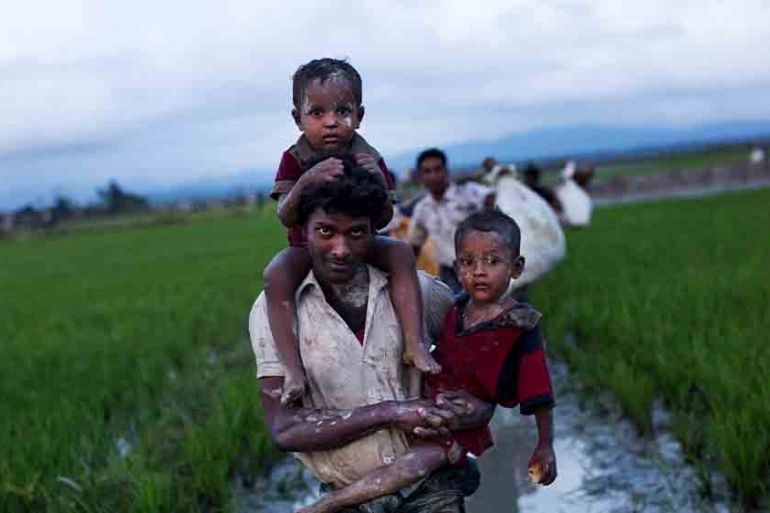
A brutal crackdown on the minority Rohingya has brought Myanmar to the UN’s highest court and charges of genocide.
Aung San Suu Kyi, former political prisoner, Nobel Peace Prize winner and now Myanmar’s civilian leader, is in the Netherlands to defend the country against charges of genocide in relation to a brutal 2017 crackdown on its Rohingya minority.
Around 740,000 mostly Muslim Rohingya fled into neighbouring Bangladesh when the military swept through villages in western Rakhine state after an armed group attacked a number of security posts.
The United Nation’s top court, the International Court of Justice (ICJ), will start hearing the case brought by The Gambia against Myanmar on Tuesday.
The International Criminal Court has also approved a full investigation of allegations of crimes against humanity committed during the military crackdown, while Aung San Suu Kyi herself has been accused of committing crimes against the Rohingya in a case brought in Argentina.
Myanmar has denied charges of genocide.
Here is a timeline of events from 2017:
On August 25, the Arakan Rohingya Salvation Army (ARSA), later declared a ‘terrorist’ group by the government, attacks more than 30 police posts, reportedly killing 12 members of security forces.
As the clashes worsen, thousands of Rohingya begin to flee across the border into Bangladesh.
The Rohingya join some 200,000 who had fled to Bangladesh during earlier waves of violence.
Many speak of abuses by the army and members of the mostly Buddhist ethnic Rakhine.
The United Nations High Commissioner on Human Rights calls the military operation in the state a “textbook example of ethnic cleansing”, citing satellite imagery and accounts of extrajudicial killings.
In her first statement on the crisis on September 19, Aung San Suu Kyi promises to hold those who have committed rights abuses to account, but refuses to blame the army.
She adds that she is open to bringing some of the Rohingya home pending a “verification process”.

Army commander-in-chief, Senior General Min Aung Hlaing, tells US ambassador Scot Marciel that the Rohingya are not natives of Myanmar.
Aung San Suu Kyi makes her first visit to Rakhine since the crackdown and urges people “not to quarrel”.
|
|
The UN human rights chief warns of possible “elements of genocide” in the Rakhine crackdown, and calls for an international investigation.
Two Reuters journalists – Wa Lone and Kyaw Soe Oo – are detained in Yangon and accused of breaching the colonial-era Official Secrets Act. The two were working on an investigation into a massacre of Rohingya men at the village of Inn Din, where the military later say they have found unidentified bodies in a mass grave.
The US imposes sanctions on 13 “serious human rights abusers and corrupt actors” including the general who oversaw the crackdown.
The military says its soldiers murdered 10 captured Muslims in Inn Din during “insurgent attacks”. Their bodies were the ones discovered in the mass grave.
Myanmar’s military is building bases where some Rohingya homes and mosques once stood, Amnesty International says.

Myanmar jails seven soldiers for the killings in Inn Din. Wa Lone and Kyaw Soe Oo remain on trial and in September are found guilty of breaching the Official Secrets Act and sentenced to seven years in prison.
Myanmar sets up a commission to investigate allegations of human rights abuses in Rakhine.
|
|
UN investigators call for senior Myanmar officials to face genocide charges over their treatment of the Rohingya, saying the military carried out mass killings and gang rapes of Rohingya with “genocidal intent”.
The actions of the armed forces “undoubtedly amount to the gravest crimes under international law”, it said in a report based on 875 interviews with witnesses and victims, satellite imagery and verified photos and videos.
Marzuki Darusman, the chair of the United Nations fact-finding mission on Myanmar, says Rohingya who remain in the Buddhist-majority country “continue to suffer the most severe” restrictions and repression.
“It is an ongoing genocide that is taking place,” Darusman said, as he prepared to brief the Security Council on his team’s findings.
Myanmar’s military says it has established a military court to investigate its conduct during the 2017 crackdown.

In a damning report, the United Nations fact-finding mission in Myanmar warns that the Rohingya still in the country live in deplorable conditions and at “serious risk” of genocide.
“Myanmar continues to harbour genocidal intent,” the investigators said in their report.
Wa Lone and Kyaw Soe Oo are freed under a presidential amnesty. A few days later, the soldiers jailed over Inn Din are given early release.
International pressure on Myanmar grows as The Gambia takes the country to the ICJ, the ICC says it will conduct a full investigation of allegations of crimes against humanity during the military crackdown, and Aung San Suu Kyi is accused of committing crimes against the Rohingya in a case brought in Argentina
Suu Kyi announces she will lead the Myanmar delegation to The Hague and defend the country against charges of genocide.
The military begins a rare courts-martial of soldiers and officers from a regiment deployed to Gu Dar Pyin village, the site of an alleged massacre of Rohingya. Military spokesman Zaw Min Tun says the men were “weak in following the rules of engagement”.