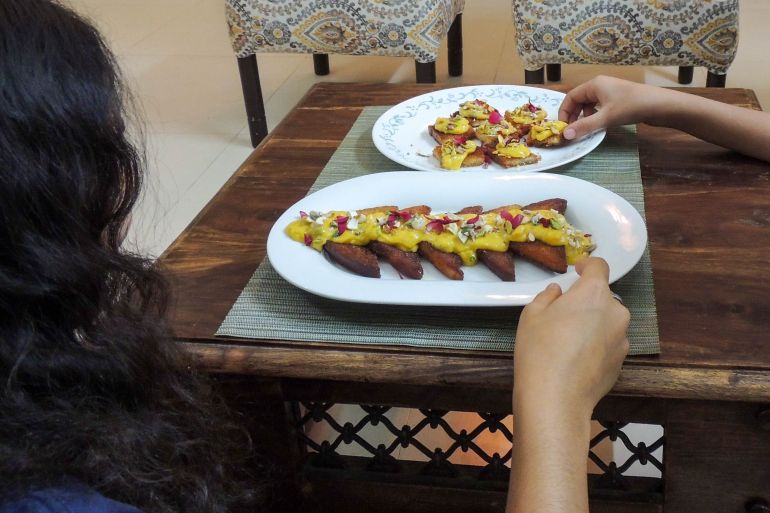
One of India’s most popular street foods is regularly prepared in the Ahmad family’s kitchen, much to the delight of 12-year-old Ibrahim.
For Ramadan, Fork the System brings you stories of family, connection, and the dishes that made the month special for our guest chefs.
Rarely is the cook of a traditional family favourite a child, but in the case of 13-year-old Sumaiya Ahmad, her love of experimenting in the kitchen means she’s already pretty experienced.
This Ramadan, she is making a lot of shahi tukda – a crisp-creamy, bread-based dessert popular with many Indians and found in food stalls everywhere for people to break their fast with a quick hit of indulgence, or as a sweet finish to their meal.
“The only problem is that I have schoolwork to finish. Only then I am allowed to venture into the kitchen and try something new,” Sumaiya giggles.
“But I always help you!” her 12-year-old brother, Ibrahim, exclaims hurriedly.
“Why don’t you make shahi tukda for iftar today?” he wheedles, not unexpectedly. The (very) young man is fasting for the first time this Ramadan and is always hoping for a sweet treat when he breaks his fast – and shahi tukda is definitely his favourite.
“You had it just the other day! Let me try a new dessert today,” Sumaiya shoots back, but the small smile on her face says Ibrahim will get what he wants.

“You know, earlier my mother didn’t want me in the kitchen, I used to make a mess,” she says, “But now I have Ibrahim helping me.”
“Yes, yes, I do the dishes and cleaning when she makes shahi tukda,” Ibrahim says eagerly.
Sumaiya, Ibrahim and their parents Suhaib and Fatima are a typical family of four in the Indian capital, New Delhi.
Suhaib came to New Delhi from his small town in the Moradabad district, Uttar Pradesh, in search of a better life for his children.
His wife Fatima is a homemaker and an excellent cook, as he proudly proclaims, fondly describing the biryani and kebabs she makes as “our all-time favourite iftar food”.
A lot of things changed for the family when they moved to the big city, including what they ate, even though the simple biryani and kebabs remained on the table.
“Back home, we enjoyed Ramadan by celebrating abundance, even in the simplest of things, especially food,” explained Suhaib.
“We grew up having simple traditional dishes such as khichdi [rice and lentils], haleem [a stew of meat pounded with lentils and wheat], biryani [rice cooked with meat, chicken or veggies], kebabs [ground beef skewers] and sheer [a pudding of vermicelli, milk, saffron, dates and dried fruit].

“But children today experiment with food. They are exposed to many cuisines on social media. That’s where my daughter, Sumaiya, learned how to make shahi tukda, which is a traditional dessert but not very commonly prepared at home. Now we thoroughly relish it, especially Ibrahim.”
Ibrahim’s sweet tooth and the lengths he will go to to make sure he’s getting the dessert he wants reminds Suhaib of his father.
“Our home would be full of children, uncles, aunts, cousins and neighbours for iftar, [my father] would insist that sheer be included in almost every sumptuous feast, especially during the last few nights of Laylat al-Qadr,” he said, adding that his mother would end up making sheer often during the holy month, much like Sumaiya ends up indulging her brother now.
“He would keep tip-toeing into the kitchen to ensure that the meal was complete with his favourite sweet. If he had his way, he would have sheer every day,” Suhaib chuckled.
Like his grandfather before him, Ibrahim is prone to hovering in the kitchen, hoping shahi tukda is on the menu.
“The closure to every meal should be shahi tukda,” Suhaib said, looking fondly over at his son.

For the Ahmads, Ramadan brings back memories and enhances the creation of new ones.
Suhaib still values the lessons his father taught him about abstinence during Ramadan.
“I would ask him why Allah wanted us to be hungry during Ramadan. Why would he want to punish us this way?
“But he explained how it was Allah’s wish to help us experience hunger so that we develop empathy towards those who can’t afford a decent meal,” he said. “This has been etched in my memory.”
Suhaib, in turn, has passed these teachings on to his children, happy that they have started to understand the importance of fasting.
With more family and loved ones expected during the last 10 days of the holy month, Fatima and Sumaiya are looking for new recipes to prepare but shahi tukda is still high on their list because it is always a hit.
“This is a simple recipe with very distinct flavours. Its ingredients are available in almost every Indian household. That’s [why] I whip it up so often. If the rabri is done right, the rest is easy-breezy,” said Sumaiya.
Fatima nods. “My family loves simple food, which has been passed down from generation – like sheer. But … shahi tukda is our favourite. It flies as soon as guests arrive,” she said.

Shahi in Urdu means royal, and tukda means a piece. So this dessert is a royal piece not just by name but in taste as well. It is believed that shahi tukda was the favourite iftar meal of the Mughal emperors.