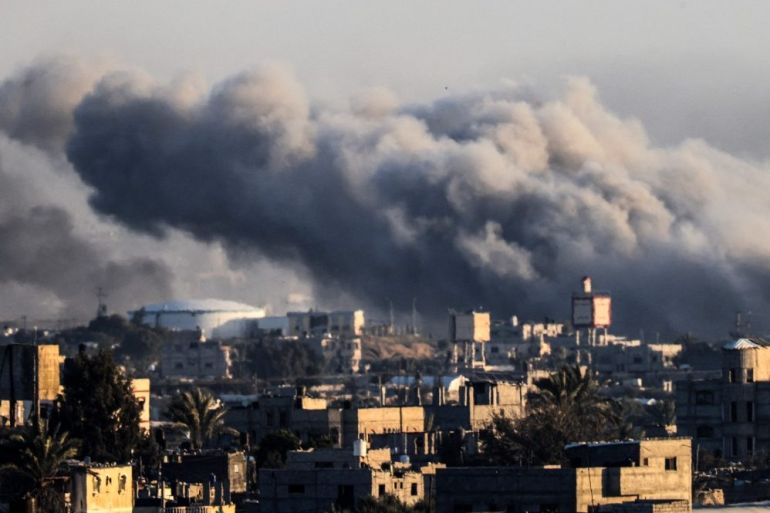
On Sunday, Netanyahu turned down a Hamas offer to end the war. It’s only the latest in a long history of Hamas proposals for long-term truces that Israel has rejected.
Ramallah, occupied West Bank – Israel and its Western allies have long dismissed the Gaza-based Palestinian armed group and political movement, Hamas, as illegitimate and have refused to engage with it, labelling it as a “terrorist organisation”.
This narrative has become ever more apparent since October 7, when Hamas launched an attack just outside the besieged Gaza Strip on Israeli territory, killing some 1,140 people, Israeli officials said.
Israel launched a brutal military campaign on the Gaza Strip as Prime Minister Benjamin Netanyahu, who has equated Hamas with ISIL (ISIS) and Nazis, pledged to “eradicate” the Palestinian group in the wake of the October 7 attacks.
More than 25,000 Palestinians have been killed and 90 percent of Gaza’s 2.3 million population has been displaced in one of the most violent military assaults in modern history, which many have labelled as “genocide”. South Africa has taken Israel to the International Court of Justice (ICJ) on charges of genocide.
Since October 7, Israel has described Hamas as an existential threat. It has argued that it needs to destroy the group.
Yet, in 2017, Hamas revised its original 1988 charter to recognise, in effect, a two-state solution — and therefore the existence of Israel as a legitimate entity. This, even as Israel insists it can no longer allow Hamas to exist, and as Israeli politicians, led by Netanyahu, have ruled out a two-state solution.
On Sunday, Netanyahu rejected a Hamas proposal to end the war and release more than 100 captives held by the group, in exchange for a withdrawal of Israeli forces, the release of Palestinian prisoners in Israeli jails and recognition of Hamas governance over Gaza.
A look into the history of Hamas — among Palestine’s most popular resistance fronts — suggests that its political leadership has, over the years, proposed numerous long-term truces or ceasefires to Israel in exchange for the realisation of a sovereign independent Palestinian state.
Israel has rejected those offers, arguing that Hamas could not be trusted to adhere to any long-term ceasefire, and insisting that the proposals for short-term pauses in fighting were insincere and strategically aimed only at helping the armed movement regroup from losses.
Sunday was only the latest instance of Israel rebuffing those offers.
The Hamas movement was founded in 1987, two decades after Israel’s 1967 military occupation of the remaining Palestinian territories it failed to capture in 1948. Its leaders were shaped by the hard realities of occupation, which was marked by mass arrests of Palestinians, expropriation of Palestinian lands and control of resources.
More than half a million Palestinians were arrested and tried in Israel’s military-run courts between 1967 and 1987, some 1,500 Palestinian homes were demolished, and thousands of other people were forcibly deported.
After Hamas won the 2006 elections in Gaza, its leader Haniyeh said the group accepted a state on the 1967 borders and all the decisions taken by the PA and the Palestine Liberation Organization (PLO), but there were no takers.
Hamas leaders have also backed the 2002 Arab Peace Initiative that called for the withdrawal of Israeli forces from territories occupied in 1967, the right of Palestinian refugees to return to the homes they have been displaced from since 1948, and the formation of a sovereign independent Palestinian state in return for Arab recognition of Israel.
But Hamas’s offers were repeatedly dismissed by Israel and ignored by its Western allies, including the United States, despite Washington’s claims of playing the role of an “honest broker” in the conflict.
“Hamas has always said that they are ready to offer a truce and to stop targeting civilians if the [Israeli] occupation removes its settlers,” Tareq Baconi, author of Hamas Contained: The Rise and Pacification of Palestinian Resistance, told Al Jazeera.
At least 750,000 Israelis live in hundreds of fortified illegal settlements and outposts across the occupied Palestinian territories of the West Bank and East Jerusalem, the vast majority of which have been built either entirely or partially on private Palestinian land.
In 2017, Hamas formally amended its 1988 charter, announcing once again that it would accept a Palestinian state on the 1967 borders.
“The Hamas thinking from the very start was clear: ‘We are not facing a religious war’,” Meshaal told Al Jazeera at the time.
“Hamas, ever since its inception, realises the nature of the struggle against the Israeli occupier, that it is not a struggle because they are Jews, but because they are occupiers.”
Israeli officials dismissed the new policy paper as “lies”. In a video, Netanyahu symbolically threw the document into a bin, saying it was an attempt to deceive the world.
However, some analysts say that Israel has not shown interest in a political settlement, whether with Hamas or other Palestinian political parties such as Fatah, which governs the occupied West Bank.
“The issue is not about Gaza,” Sari Orabi, a Ramallah-based analyst, told Al Jazeera. “It’s also not about whether Israel or Hamas started the war. There are daily killings and assaults in the occupied West Bank, there are attacks on Al-Aqsa Mosque, there are prisoners and checkpoints.”
“The people in Gaza are refugees. They were isolated and separated from the rest of the Palestinian people,” he said.
The vast majority of Gaza’s population are refugees, expelled from their cities and villages in what is now the state of Israel by Zionist militias in 1948.
Analysts also blame Israel for the failure of the Oslo Accords, signed in 1993 and 1995, between Israel and the PLO – which was representative of the Palestinian people at the time.
The agreements led to the formation of the PA, an interim, five-year governing body meant to lead to an independent Palestinian state comprising the occupied territory of East Jerusalem, the West Bank and the Gaza Strip.
However, 30 years into its existence, the PA has failed to create a state in the face of Israeli occupation, illegal land grabs and settlements. Hamas took control of Gaza from the PA in 2007.
While there was initial support for the Oslo Accords among Palestinians, the failure to reach a final peace agreement by 1999 and the growing settlement projects particularly under Netanyahu, left many disappointed. In a leaked video in 2010, Netanyahu boasted how he made sure the Oslo Accords did not succeed.
The hopes of the Oslo Accords have turned into despair as Israeli policies under successive governments continued to undermine the PA and its aspirations.
Today, the PA has limited administrative rule over pockets of the occupied West Bank, while Israeli settlements, which are considered illegal under international law, have grown rapidly. The settler population in the occupied West Bank and East Jerusalem has grown from 250,000 Israelis in 1993 to more than 700,000 this year.
“The Israelis wanted Oslo [Accords] because that’s how they maintain their colonisation; by maintaining the facade of a peace process,” said Baconi.
“Hamas was showing a mirror to the Israelis to say: If you’re actually talking about the possibility of ending the occupation, then end it,” he told Al Jazeera.
“That was their offer instead of the [1993] Oslo agreements – that they would stop armed resistance if Israel left Palestinians be in the eastern side of Jerusalem, the West Bank and Gaza.”
