In Pictures
In Pictures: Nigerian women use fashion to ease the trauma of war
In displacement camps in northeast Nigeria, dressmaking helps women earn an income and dream of a brighter future.
In Pictures
In displacement camps in northeast Nigeria, dressmaking helps women earn an income and dream of a brighter future.
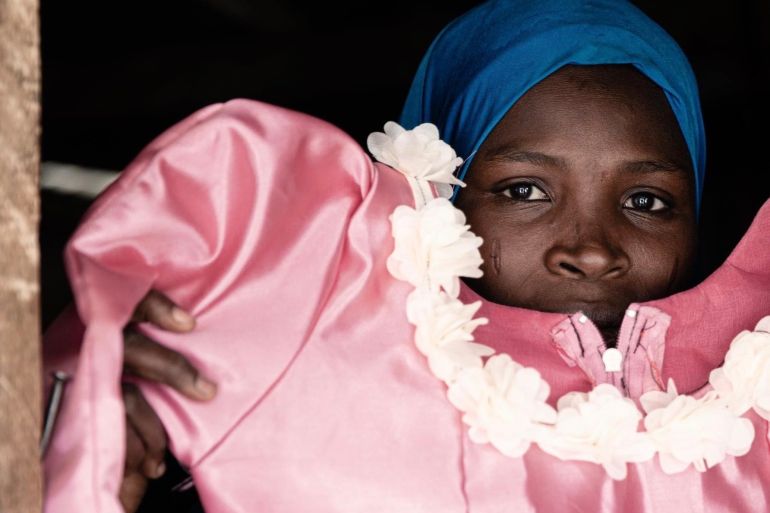
In the flat, colourless landscape of the displacement camp – the miles of sand interrupted only by rows of identical tarpaulin tents and huts – a young woman sews a bright pink dress.
Dressmaker Aisha Ismail is slender and shy. She is 28 but looks much younger. Alone, she takes care of her four children and two younger siblings – a common arrangement in camps across northeast Nigeria, where women and children make up 80 percent of the population. During the course of the decade-long armed conflict between armed groups and Nigeria’s military, nearly two million people have been forced from their homes.
In Dalori camp in Maiduguri, where Aisha lives, the landscape is familiar: beyond sandy alleyways and rows of identical makeshift structures are hay fences, children playing with empty cans and plastic bottles, and stalls selling groceries (carefully rationed). The scenery is dominated by subdued hues of grey and yellow. To survive, women mostly depend on meagre earnings from daily labour, and on humanitarian aid. After the lockdown measures meant to prevent the spread of COVID-19 strained the already fragile local economy, things worsened. Prices climbed and spirits sank.
In the tailoring shop Aisha set up on the porch of her shelter, she works determinedly through a pile of brightly-coloured fabrics. One of the most important Muslim holidays was approaching and, for local tailors, it was the busiest time of year. The young woman created elaborate dresses, including a pink satin one with white flowers. There was something innocent about it, as if the dress materialised from a little girl’s fantasy world and landed in the middle of this camp in the midst of a deadly conflict.
Aisha’s creation, striking against its starker surroundings, is not just a symbol of a life now far removed from her daily reality; it is also a testament to the hidden sacrifices and unbending will behind the elongated silhouettes and frilly hems seen hanging in shops like hers.
The journey of a dress often begins with an invitation. “A woman usually receives an invitation to a wedding two months before the date,” explains Hawa Bukar, another tailor living in Dalori camp. “Then, every single day she goes to the bush to collect and sell firewood. It is hard labour and it can be dangerous, but they still go. Often they manage to collect enough money and buy the fabric only one day before or on the day of the wedding.”
That’s when her clients appear at her doorstep, usually carrying a picture on their mobile phone with the design they fancy. “Then I will rush to make the dress on time,” she says.
“Even if I see that the dress will cost more than the budget they have for it, I still try to make it,” Hawa sighs. “Most of the time, I sacrifice my own wages.”
Hawa’s father was a tailor and she received a sewing machine as part of her dowry. When her hometown of Bama in the Lake Chad region came under attack, the family fled. Their house, together with her sewing machine, was destroyed in a fire. When they arrived at the camp, Hawa borrowed sewing machines from other people whenever she could, to help her earn a living. Then she applied for a small grant from the Red Cross and bought her own. The machine has turned into a lifeline for the family who left everything behind.
It is a tradition to wear new clothes to attend a wedding. Many people in the camps cling to tradition, having lost everything else: their villages, familiar landscapes, the work they did, and a world they knew how to navigate. But for many women, a new dress is about more than paying respect to tradition. Their elaborate outfits help them rise above their circumstances; help them forget about the poverty, the hunger, and the rows of identical shelters that are now their only home. Putting on a new dress to go to a wedding may also prove to themselves and everyone else how far they’ve come – that they are still in control of their own life, whatever the cost.
In her house in the Bakassi camp in Maiduguri, Aishatu Mohammed, 38, a widow and a mother of 10, is teaching her teenage daughter to sew. “She has to learn how to do things to be independent,” the soft-spoken Aishatu says. Sunlight pierces through the holes in the tarpaulin ceiling above their heads, while the two women, mother and daughter, sit barefoot on the plastic mat, repositioning and cutting a piece of bright purple fabric. It’s the middle of the dry Harmattan season and clouds of white dust hover above the scorched, naked earth.
Aishatu buried her husband after he was killed in an attack on their village. Traditionally, burying the dead is a task that belongs exclusively to men; but with no men remaining at the time, it fell to her. With her voice barely audible, Aishatu recounts how she then fled the village on foot with her children, running past dead bodies decomposing by the side of the road, and the sound of explosions. There are long silences between her words as she recalls the horrors of the journey.
After she’s done speaking, Aishatu goes to fetch water at a nearby water point. She wears a long, fitted skirt, a top and a headscarf, all made from the same bright yellow fabric. A long orange gauze shawl is wrapped around her neck and floats behind her in the wind. On her head is a large plastic bucket filled with water; she carries it effortlessly, as if it weighs nothing at all.
Walking through the desolate sandy alleyways that are filled with hovering dust, Aishatu almost illuminates the dull surroundings with her presence. In her bright outfit, she looks out of place; but at the same time, she belongs. This landscape is part of her story; the story of a woman who has lived through horrors and triumphed. She is bigger than the camp, bigger than her circumstances. And everything about the way she looks and carries herself says so.


