In Pictures
‘We are tired, angry and mad’: 180,000 women march in Mexico City
Thousands take to the city’s streets on International Women’s Day to protest rampant violence.
In Pictures
Thousands take to the city’s streets on International Women’s Day to protest rampant violence.
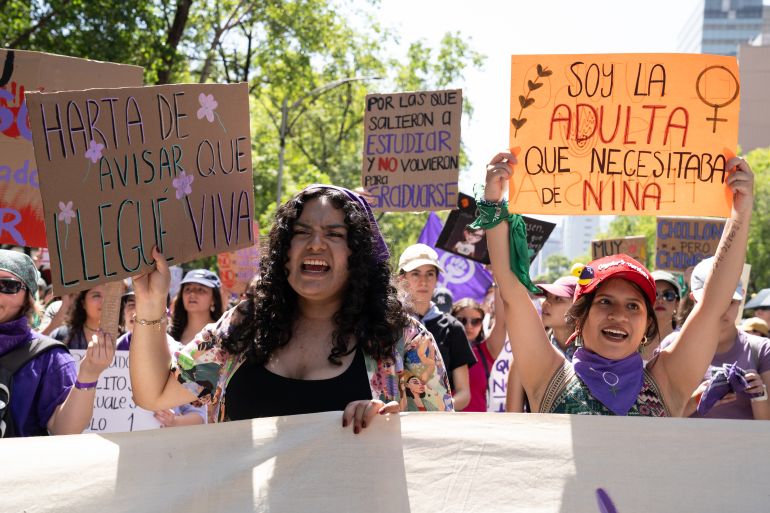
By midday on March 8, 2024, small groups of women dressed in lilac, wearing purple bandanas tied around their wrists, hair and necks, started to congregate in Mexico City. Soon they comprised an 180,000-strong crowd, marching and chanting together on International Women’s Day.
The chants were amplified by megaphones or voices directed upward, faces turned to the sky. With arms in the air, they yelled about their strength in numbers, the lack of police protection and their intent to fight for their rights.
“No somos una, no somos diez! ¡Somos un chingo, cuéntanos bien!”
(“We are not one. We are not 10. We are a s***load, count us right.”)
“There are so many women,” said Ileana Alvarez Mendoza, 40, who attended the march with her 10-year-old daughter, Emiliana Leyva Alvarez. “How can the government say we aren’t that many?”
Nearly 10 women were killed every day in Mexico in 2023: there were more than 2,500 female victims of homicide and over 800 femicides, according to the Secretary of Security and Citizen Protection. In 2021, more than 40 percent of women over 15 had experienced some form of violence in their childhood, according to Mexico’s National Institute of Statistics and Geography (INEGI).
A group of women at the side of the march near Mexico City’s opera house, the Palacio de Bellas Artes, stood coated in streaks of purple paint, holding up signs saying “Paint me if you have been abused.”
A never-ending line waited patiently to take a turn with the paint brushes.
“¡La policía no me cuida! ¡Me cuidan mis amigas!”
(“The police don’t look out for me. My friends do.”)
Mehida Perez Martínez, a 45-year-old from Cuernavaca, a town near Mexico City, said she was marching for her children and for herself, explaining that she lives in a safe area in Mexico City but is “constantly aware of the men surrounding me”.
“Anyone could be a predator and I can’t trust the police, especially men,” said the mother of three, who joined the Amnesty International contingent of women. Dressed in a lilac tank top and baseball cap, she marched holding a sign that said, “My mom taught me to fight for my rights”.
“Our judicial system was created by men and is run by men. Even if I wanted justice, I probably couldn’t access it. Therefore, I try to prevent violence and protect myself by avoiding places and times that could be dangerous,” said Perez.
Her fear is justified. Impunity for homicide is around 94 percent, confirmed a study by the think-tank Mexico Evalua in 2021. Women have to be wary of police in Mexico; a government study released in 2022 found that the majority of women who are detained by the police have been abused, a third of them sexually.
The march ended in Mexico City’s central square — the Zocalo — that is overlooked by government buildings and the Metropolitan Cathedral. As the square filled with protesters, people sought relief from the scorching 31C-degree (89F-degree) heat in small pockets of shade under tents run by street vendors offering cups of corn, sliced mangos and potato crisps drenched in lime and chili sauce. Sunstroke was the most common complaint among the 112 patients who received medical attention during the march.
Behind heavy-duty metal barriers with overhanging metal lips, hundreds of police lined up, standing far enough back to avoid the near-constant barrage of plastic cups, rubbish, flashbangs and purple flares being lobbed by angry protesters. Taking advantage of any openings in the barriers, women taunted the police, showing their middle fingers or pushing lit cardboard banners through the gaps.
A group of women dressed in black with balaclavas and ski masks, referred to as the “Black Block”, slammed hammers against the metal fence.
“They represent the part of feminism that is angry,” explained Perez. “We tried to have our voices heard, but it did nothing. Yes, we are angry and we have a right to be so.”
“We are tired, angry and mad”, she added.
“¡Ni una más, ni una más! / ¡Ni una asesinada más!”
(“Not one more. Not one more assassination!”)
It was the first march for 10-year-old Emiliana Leyva Alvarez, but she said she hopes to go to more. Wearing pink socks and a purple T-shirt, she noted it was exciting to be there and “attend something that matters to everyone, not just to one person”.
She said she thinks things will change because of the march, “even if it’s just a small thing”.
“What kind of small things might change?” Emiliana was asked.
She paused, then said “The same pay for men and women or that fewer women are killed every day.”
![Over 180,000 protesters marched through Mexico City with various demands including access to justice, freedom from violence and fear or with photos of people they were accusing of rape or violence. Some banners demanded that girls grow up without violence whilst others were specific to absent women who had been killed [Lexie Harrison-Cripps / Al Jazeera]](https://www.aljazeera.com/wp-content/uploads/2024/03/IWD-Mexico-08-03-24_8M.1_230-1710076769.jpg?fit=1170%2C780&quality=80)
![Before the official start of the march, women came together from different parts of the city to join the crowd that would become over 180,000-strong [Lexie Harrison-Cripps / Al Jazeera]](https://www.aljazeera.com/wp-content/uploads/2024/03/IWD-Mexico-08-03-24_8M.1_036-1710076596.jpg?fit=1170%2C780&quality=80)
![Women invite survivors of abuse to apply paint to their T-shirts. Most of the survivors cried as they painted or hugged the painted women [Lexie Harrison-Cripps / Al Jazeera]](https://www.aljazeera.com/wp-content/uploads/2024/03/IWD-Mexico-08-03-24_8M.1_486-1710076887.jpg?fit=1170%2C780&quality=80)
![Two protesters link arms to form a human barrier around their contingent. Some protesters used ropes, but others held hands to keep their group together in the throng of hundreds of thousands of people [Lexie Harrison-Cripps / Al Jazeera]](https://www.aljazeera.com/wp-content/uploads/2024/03/IWD-Mexico-08-03-24_8M.1_741-1710076965.jpg?fit=1170%2C780&quality=80)
![Periodically the Zocalo would fall silent as women dropped to their knees and raised a fist. This gesture was also used when a child went missing during the march — the women quickly organised themselves to quietly drop to a knee as someone shouted the child's name. The little girl was found within minutes of the search [Lexie Harrison-Cripps / Al Jazeera]](https://www.aljazeera.com/wp-content/uploads/2024/03/IWD-Mexico-08-03-24_8M.2_447-1710077341.jpg?fit=1170%2C780&quality=80)
![A woman calmly tries to attach a new poster to the metal barriers as the police fire chemical powder through the gaps, forcing them to run away. The police use fire extinguishers to fire the chemical powder that irritates eyes, skin and makes it difficult to breathe [Lexie Harrison-Cripps / Al Jazeera]](https://www.aljazeera.com/wp-content/uploads/2024/03/IWD-Mexico-08-03-24_8M.2_636-1710077576.jpg?fit=1170%2C780&quality=80)
![Women climb on the metal barriers to shout and heckle the police officers waiting behind the barrier [Lexie Harrison-Cripps / Al Jazeera]](https://www.aljazeera.com/wp-content/uploads/2024/03/IWD-Mexico-08-03-24_8M.2_264-1710077136.jpg?fit=1170%2C780&quality=80)
![Protesters burn their banners and cards in front of the barriers as police officers in helmets, seen through the window, wait behind the protection of the barriers. Periodically, the police sprayed chemical powder through the gaps to disperse the protesters [Lexie Harrison-Cripps / Al Jazeera]](https://www.aljazeera.com/wp-content/uploads/2024/03/IWD-Mexico-08-03-24_8M.2_337-1710077270.jpg?fit=1170%2C780&quality=80)
![Hundreds of police stand far behind metal barriers as protesters shout at them and throw light objects such as plastic cups or other rubbish. Some protesters used spray paints to start fires near the metal barriers, burning banners or pieces of cardboard [Lexie Harrison-Cripps / Al Jazeera]](https://www.aljazeera.com/wp-content/uploads/2024/03/IWD-Mexico-08-03-24_8M.2_227-1710077045.jpg?fit=1170%2C780&quality=80)
![The police periodically sprayed chemical powder through the gaps in the barrier causing the protesters to flee in search of clean air [Lexie Harrison-Cripps / Al Jazeera]](https://www.aljazeera.com/wp-content/uploads/2024/03/IWD-Mexico-08-03-24_8M.2_524-1710077428.jpg?fit=1170%2C780&quality=80)
![A protester holds her finger up to the hundreds of police lined up safely away from the metal wall as other women bang and chant [Lexie Harrison-Cripps / Al Jazeera]](https://www.aljazeera.com/wp-content/uploads/2024/03/IWD-Mexico-08-03-24_8M.2_737-1710077724.jpg?fit=1170%2C780&quality=80)