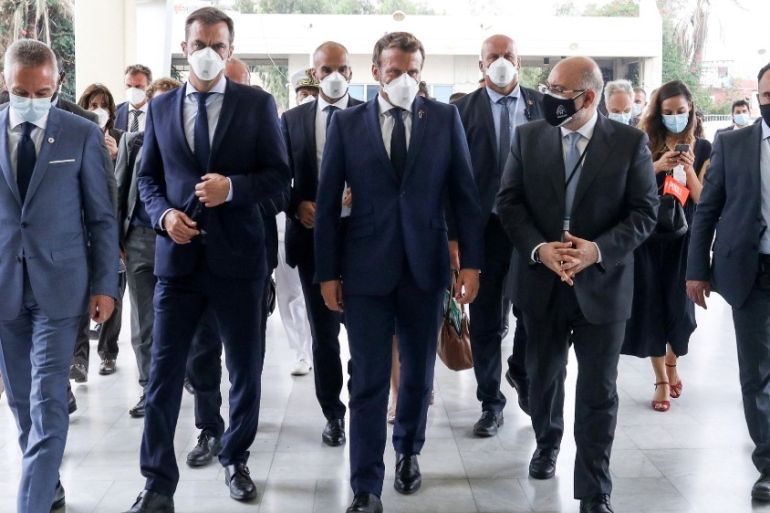
France proposed a detailed draft list of sweeping reforms it is pressuring Lebanon to implement by year’s end.
Beirut, Lebanon – French President Emmanuel Macron, in a visit to Lebanon, has offered to help provide the crisis-hit nation with vital aid if its politicians make good on long-overdue reforms.
Speaking at the palatial French ambassador’s residence in Beirut from where Greater Lebanon was proclaimed by colonial France 100 years ago, Macron said on Tuesday he would rally international aid at an October donor conference aimed at rebuilding the capital after a devastating explosion last month and halting the country’s economic demise.
But “we will not give Lebanon a carte-blanche, or a blank check,” he added, noting that everything was conditional on whether the country’s fractious leaders could unite around change.
Even before the August 4 explosion that killed at least 190 people, wounded more than 6,000 and damaged wide swaths of Beirut, Lebanon had been drowning in economic crisis.
Its government was seeking $20bn in financial aid, half from an International Monetary Fund (IMF) programme and the other half from development funds pledged by a host of donor nations at a 2018 donor conference. An additional sum of nearly $5bn is now needed for the reconstruction of Beirut, as well as humanitarian assistance.
Macron said Lebanese leaders had pledged to form a government within 15 days, which must then implement a host of reforms within one to three months.
Before the meetings on Tuesday, the French embassy distributed a “draft programme for the new government”, to the heads of political blocs, which Al Jazeera has obtained.
The French draft proposals get into the nitty-gritty details of public policy in Lebanon, underlining some laws and projects and sidelining others.
Here are the main points:
The government will prepare and disseminate a coronavirus pandemic control plan “that includes support for the most vulnerable people”.
It will strengthen social safety net programmes for the population.
The government will facilitate the distribution of humanitarian aid – provided by the international community and coordinated by the United Nations – in an “expeditious, transparent and effective manner”.
It will put in place governance mechanisms to allow the disbursal of aid in a “transparent and traceable manner”.
It will begin reconstruction based on a needs assessment by the World Bank, EU and UN that estimated the value of damages caused by the explosion at up to $4.6bn.
The government will rapidly launch tenders for the reconstruction of Beirut’s port according to “neutral” standards.
It will conduct an “impartial and independent investigation” into the port explosion “that enables the full truth to be established regarding the causes of the explosion, with the support of Lebanon’s international partners … within a reasonable timeframe”.
The government will regularly exchange views with civil society regarding its programme and the reforms it entails.
It will immediately resume stalled negotiations with the IMF and rapidly approve measures requested by the lender, including a capital controls law and a “full audit” of the Central Bank’s accounts.
The French proposal also called for the approval of a timetable for working with the IMF within 15 days of the government gaining confidence.
It goes on to propose time limits for sector-specific reforms.
Within one month, the government will:
Appoint officials to the National Electricity Regulatory Authority according to Law 462/2002 “without amendments”, and provide the Authority with the resources to carry out its work.
Launch tenders for gas-fired power plants to plug Lebanon’s massive energy gap.
“Abandon” the controversial Selaata power plant project in its current form. The project is one President Michel Aoun and his Free Patriotic Movement party have insisted on.
Within three months, the government will:
Within one month:
Within one month, the government will:
Hold a meeting to follow up on the 2018 donor conference in which the international community pledged $11bn in soft loans, and launch a website dedicated to following up on projects, financing and related reforms.
Complete judicial, financial and administrative appointments, including members of the Supreme Judicial Council, the Capital Markets Authority and regulatory bodies in the electricity, telecommunications and civil aviation sectors, “in accordance with transparency and competency-based standards”.
Approve in Parliament a law on the independence of the judiciary.
Launch a study on Lebanon’s public administration by an “independent international institution” such as the World Bank or the Organisation for Economic Co-operation and Development (OECD) “with a specialised office”.
Within one month, the government will:
Appoint members of the National Anti-Corruption Commission and grant it the resources to launch its work.
Launch the track to accede to a 1997 OECD treaty on combating corruption.
Implement customs reforms with immediate effect.
Within three months, the government will:
Within one month:
Parliament will prepare, adopt and implement a bill on public procurement reform.
The government will grant the Higher Council for Privatization the human and financial capabilities necessary to carry out its tasks.
Within one month:
By the end of the year:
At his speech later on Tuesday, however, Macron seemed to walk back his proposal for early polls, saying there was “no consensus” on early elections and that other reforms were the priority.
