Why are Tunisia’s parliamentary elections so controversial?
President Saied has tried to drum up support, but the opposition are boycotting and turnout is expected to be low.
Share
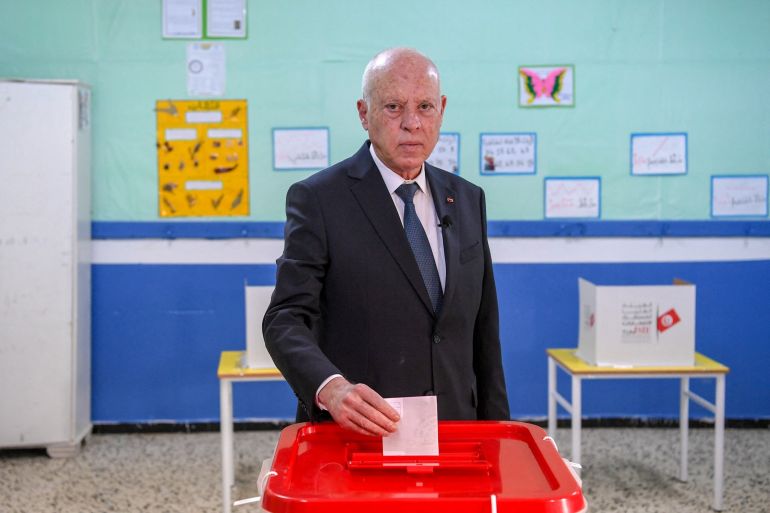
Tunisia's President Kais Saied casts his ballot at a polling station during parliamentary election in Tunis, Tunisia on December 17, 2022. [Tunisian Presidency/Handout via Reuters]
Tunis, Tunisia – Tunisians have begun voting in parliamentary elections, but with a general sense of apathy among many voters and an opposition boycott, turnout has been poor.
Saturday’s vote is the first parliamentary vote since 2019, and the first since President Kais Saied dissolved parliament last year.
The Tunisian opposition has decried Saied’s moves as a “coup”, but he says they were necessary to fight back against what he describes as a “corrupt” political elite.
Many Tunisians fear the country is sliding back towards authoritarianism 10 years on from the 2011 revolution that overthrew longtime leader Zine El Abidine Ben Ali and ushered in a period of democracy.
Here is a closer look at the elections, and why they are so controversial.
What is so different about this round of elections?
These are the first elections under Saied’s new constitution, which was voted on in a referendum held on July 25, one year to the day after his decision to sack the government and suspend an opposition-dominated parliament.
The new constitution says that the parliament is no longer a separate independent power, but under the control of the president and functions to support his work.
A new electoral law means that only individuals can run for election, rather than parties. Candidates are allowed to use party logos, but they cannot be financially backed by any political party, meaning they will have to raise their own funds to run.
The new law changed voting from a proportional representation, list-based system to a one-vote system.
The state used to give financial support to candidates to run campaigns, but under the new law, campaigns are completely self-funded. However, controversy over illegal sponsorships has already resulted in corruption investigations.
Constituency boundaries have been changed, reducing the number of seats in parliament.
How has the new system been received?
Despite attempts to drum up support, it appears that many registered voters are not expected to vote, and turnout will be low.
The number of candidates is lower than in previous elections, and some constituencies have only one candidate running, or none at all. This is particularly the case in overseas constituencies representing Tunisian citizens living abroad.
Youth and human rights groups say the new system has marginalised women and youth because of the high threshold of nominations required and the difficulty in accessing funding.
12 political parties, including Ennahda – which previously held the largest number of seats in parliament, are boycotting the elections.
Candidates are also banned from talking to the international press during their campaigns.
How will the new parliament work?
Under the new constitution, parliament is directly under the president’s control. The opposition argues that this will lead to a weak parliament dominated by the president, and serve to rubber-stamp his laws.
Individual members of parliament will still be able to propose new laws, but without political parties, it will be difficult to create blocs and alliances to push new laws through.
The parliamentary watchdog Al Bawsala says it will no longer observe the day-to-day operation of parliament as it does not want to give it legitimacy.
What comes next?
Preliminary results from the count are not expected to come out until Sunday, and possibly even later. The final results will be published in January.
The 2023 finance law will be published next week. Protests are already expected, with many Tunisians feeling that it will not do enough to solve the country’s crippling financial crisis.
Food shortages, which are already bad, are expected to worsen and the cost of living is set to increase.
Polls show that many Tunisians have lost confidence in Saied, as well as other political leaders.
Increased civil unrest is expected in the lead-up to January 14, the day Ben Ali was removed and fled the country.